
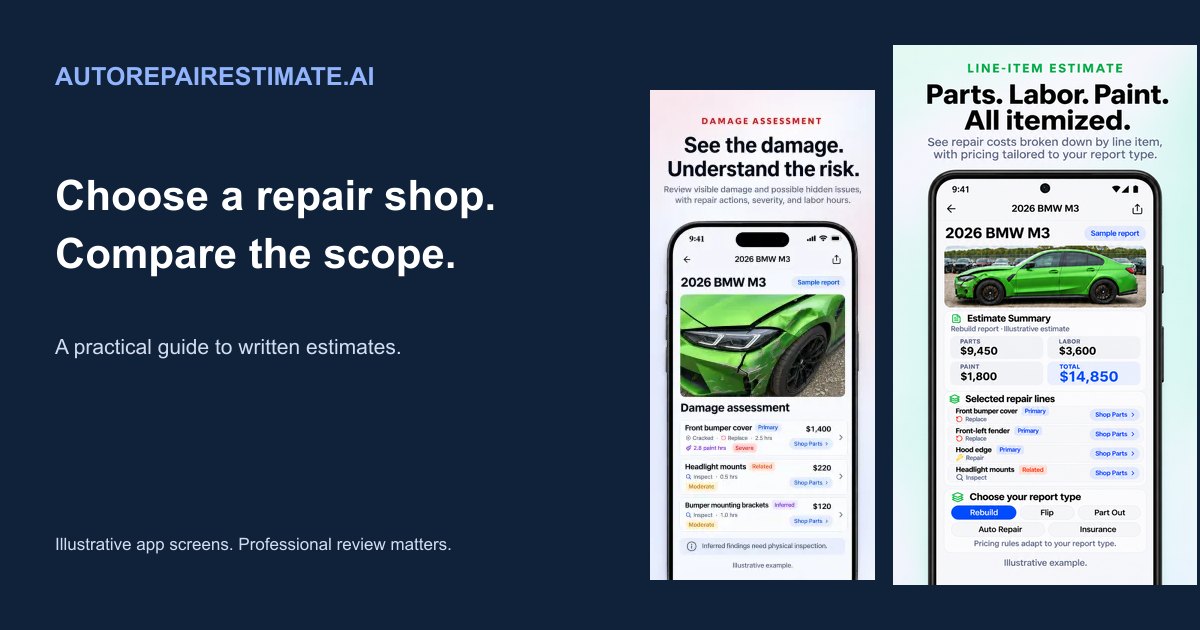
A useful repair-shop comparison starts with the work, not the total at the bottom of the page. Confirm that each shop is evaluating the same vehicle, the same concern, and a clearly described scope. Ask what has been inspected, which operations and parts are included, which costs remain unknown, and how changes will be approved. Then compare the price alongside the evidence, timing, communication, and written terms that matter to your situation.
This guide gives you a practical way to move from a directory search to an informed repair conversation. It includes a shortlist worksheet, a request template, a line-by-line comparison method, and invented examples showing why two totals can differ. The examples are teaching cases, not local price benchmarks, customer outcomes, or recommendations for a particular business. This is a consumer planning workflow, not a diagnosis, legal opinion, insurance coverage decision, or instruction to perform repairs yourself.
AutoRepairEstimate.ai is operated by AutoEstimatePro LLC. Our directory helps people discover repair businesses; a listing is a starting point for checking current services and availability. It does not, by itself, establish a shop's credentials, endorse its workmanship, or guarantee an appointment. Our separate preliminary report and mobile app can help organize questions, while the repair facility evaluates the vehicle and supplies its own scope and price. Keep those roles clear as you work through the comparison.
Find repair businesses in the directory
Start with the decision you actually need to make
Write one sentence describing your immediate objective. Perhaps you need a shop to assess a dent, explain an estimate after a collision, investigate a recurring symptom, or determine the work needed before a vehicle returns to use. These are different requests. If you ask only “How much to fix my car?” a shop may reasonably interpret the task differently from the next business you call. A clear objective makes the responses easier to compare.
Add your practical constraints without turning them into a diagnosis. You may need a location reachable by a transporter, communication by email, an estimate before a certain date, or an explanation of whether the business handles your vehicle type. Tell the shop about those needs early. If you are unsure whether the vehicle can be moved safely, ask an appropriate professional about inspection and transport rather than choosing to drive it because the nearest shop is convenient.
Separate preferences from prerequisites. A preferred pickup day might be flexible; the shop's ability to perform the required assessment may not be. A low initial figure is attractive, but it cannot compensate for a scope that does not address your concern. Put the essential requirements at the top of your notes before you collect prices. This helps you avoid choosing a business for a persuasive quote that answers a different question.
Build a vehicle and concern brief once
Prepare a short brief you can send consistently. Include the vehicle description, the concern in your own words, when it started or was first noticed, and the relevant prior work you know about. Provide the VIN when it is needed through an appropriate channel. Distinguish what you observed from what someone suggested. “The door catches when closing after the incident” describes an observation; “the hinge must be replaced” is a proposed conclusion that still needs assessment.
For visible damage, use a small set of clear photographs showing context and detail. Identify older damage separately when you know about it. Do not remove components, enter traffic, or place yourself under an unsupported vehicle to improve the pictures. If a view cannot be obtained safely, describe the limitation. A report built from incomplete images should retain that limitation rather than treating the unseen area as undamaged.
Keep the same brief as the starting point for each business. If one shop receives additional information, update the version and make the relevant information available to the other shop before comparing their responses. Otherwise, you may be measuring the difference between two information packages rather than the difference between two proposed repairs. A consistent brief also saves time: you can concentrate on each shop's answer instead of reconstructing the story during every call.
Use the directory to make a manageable shortlist
Begin with location and the kind of work described in the listing, then confirm details directly with the business. Directory information can change. A useful shortlist contains a few businesses that appear capable of evaluating your concern, together with the question you need each one to answer. It should not become a large collection of names that you contact without a clear purpose. Quality of response matters more than how many browser tabs you open.
Use a simple record for each candidate: business name, current contact source, location, work you are asking about, date contacted, response, and next step. Add a field for “confirmed by shop” so that a directory category does not become an assumed service capability. If a business says it does not perform the work, record that plainly and move on. That answer is useful filtering information rather than a reason to pressure the business into an unfamiliar job.
Avoid inferring quality from a listing's design, position, or amount of text. A complete profile can make contact easier, but the repair decision still needs current evidence about scope and service. Likewise, an empty website field does not prove poor workmanship. Treat the directory as a discovery tool and the subsequent conversation as a separate verification step. This keeps your shortlist grounded in the job you need done.
Check relevant credentials without inventing a guarantee
When credentials matter to the proposed work, ask what the credential covers and whether it is current. ASE explains that its certifications relate to technicians and specific technical areas; its driver resources include information about credentials and the Blue Seal program. A badge should prompt a precise question about the people and work involved, rather than a broad assumption that every service at a location is covered in the same way.
Source: ASE resources for drivers
Your comparison note might say, “Shop provided information about the technician's relevant certification; confirm who will perform the assessment.” Another note might say, “Manufacturer program claimed on website; current participation not yet checked.” Those entries distinguish what you have seen from what remains to be verified. You do not need to become a credential investigator, but you should avoid changing an advertising statement into a verified fact simply because you copied it into your worksheet.
Registration or licensing questions depend on location and the type of business. Use the relevant government source where a requirement applies, and ask the business to clarify its current details. Credentials are one part of your decision alongside scope, documentation, practical access, and communication. They do not tell you the final repair cost, establish the condition of the vehicle, or guarantee that a particular outcome will occur.
Read reviews for useful questions, not a verdict
Reviews can suggest topics to ask about, such as update frequency, estimate explanations, or pickup arrangements. Look for descriptions that relate to the service you need and distinguish a specific account from a vague rating. A single customer's account is not an inspection of your proposed job. Use it to formulate a neutral question rather than assuming that every visit will follow the same pattern.
For example, several recent comments about missed updates might lead you to ask, “Who will be my contact, and when should I expect the next update?” A comment about a changed estimate might lead to a question about additional-work approval. You are converting imperfect background information into a practical request. That is more useful than deciding that a star average alone establishes whether a shop can handle the repair you need.
Keep complaint research proportionate and use appropriate official channels for relevant records. Do not repeat an allegation as an established fact in your own comparison. If you discuss a review with the shop, state the operational issue you want clarified rather than demanding an explanation of someone else's private transaction. Your goal is a workable arrangement for your vehicle, supported by the information the shop can provide about that arrangement.
Make the first contact specific and easy to answer
A concise opening message can contain the vehicle, concern, requested next step, and your availability. For an invented example: “I have a 2021 compact sedan with visible damage at the right front corner. I would like an assessment and written estimate. I can provide current photographs, but the mounting area has not been inspected. Do you evaluate this type of work, and what is the process and charge for the initial assessment?” This asks for a process before assuming a final repair price exists.
Ask how the business prefers to receive photographs or documents. Send only the material relevant to the request through the intended channel. A large collection of attachments can conceal the one question that matters, while screenshots containing personal or payment information add unnecessary exposure. Keep the first package small enough that a recipient can understand the task without reading your entire vehicle ownership history.
Record the response in your shortlist. If the shop needs to see the vehicle, that does not make the response less useful than an immediate number from another business. It identifies the next step required for that shop's assessment. Compare the proposed assessment process, its cost, and what you will receive. Do not treat a fast informal reply as equivalent to a written scope based on an inspection.
Clarify what you are authorizing at the assessment stage
An appointment can involve different activities: a conversation, a visual estimate, diagnostic work, or a more involved examination. Ask what the proposed appointment includes, what it costs, and what requires further approval. Also ask what happens if you decide not to proceed with repairs afterward. The distinction helps both sides understand whether you are arranging an assessment or authorizing a specific repair operation.
The FTC recommends asking for a written estimate that identifies the condition, proposed parts, and anticipated labor, with an arrangement for approval before exceeding a specified amount of time or money. Its guidance also discusses possible diagnostic charges and differing warranty terms. Use that as a starting checklist, then confirm the actual terms and applicable local requirements for your transaction.
Source: FTC Auto Repair Basics
Write down the agreed assessment scope and keep a copy of the relevant paperwork. If the shop needs additional access or work to produce a meaningful repair estimate, ask for the explanation and price before deciding. Avoid assuming that every appointment is free or that paying for assessment obligates you to authorize all later work. The useful outcome is a clear agreement about the step you are taking now and how the next decision will be presented.
Keep a preliminary report separate from the shop's estimate
A photo-based report can organize visible findings and questions before your visit. It should travel with its date, input limitations, and status as preliminary analysis. Tell the shop which information came from your observations and which was suggested by a tool. Ask the repairer to evaluate the vehicle rather than to confirm an AI-generated conclusion. A disagreement may reveal a missing input or a different interpretation that needs explanation.
AutoEstimatePro's Car Repair Estimate & Parts app for iPhone and Android is described in its current listings as providing preliminary photo-and-VIN estimates, available parts links, and report-aware assistance. The app is free to download with in-app purchases. Its output is a planning aid; it is not the listed business's quote, an inspection, a repair authorization, or a guarantee of price or fitment. Check current purchase terms in your platform's checkout.
When the shop supplies its estimate, save it as a separate document. Keep your original report so you can see which questions were resolved, but let the shop's stated assessment and evidence speak for itself. A useful comparison does not force the two documents to have identical totals. It asks why their scopes differ and whether the information now available supports the proposed work.
Check the identity and version of every estimate
Before comparing line items, confirm that each document describes the intended vehicle and concern. Look at the identifying details, estimate date, reference number, and version. If one estimate is based only on photos and another follows an in-person assessment, label that difference. A version mismatch can make an ordinary update appear to be a pricing inconsistency when you are simply looking at two different stages of the job.
Save each version with a clear name, such as the business, date, and revision number. Keep the accompanying message if it explains what changed. Do not overwrite the earlier estimate without preserving the comparison you may need later. The point is not to accumulate paperwork indefinitely; it is to maintain a readable sequence from initial request to agreed work and final invoice.
Create a cover note with the current version from each shop and the questions still outstanding. If a quote has an expiry date or depends on parts availability, record that beside the total. A figure copied without its conditions can outlive the circumstances that made it useful. Confirm material terms again before authorizing work if the document is old or the vehicle's situation has changed.
Translate the repair scope into comparable rows
Build your comparison around operations and components, not page position. One shop may group a task while another lists several related operations separately. Create a row for each meaningful part of the job and note where it appears in each estimate. If you cannot tell whether a task is included, mark it “needs clarification” instead of assuming that an empty cell means no charge or no need.
Use columns for the proposed operation, part or material description, included labor, price, exclusions, and question. Keep the shop's original wording in a reference column. Your simplified label should help you compare without changing the proposal. For example, “front corner work” may be convenient for your notes, but it should not erase whether the document proposes repairing a cover, replacing it, or inspecting an attachment before deciding.
Ask each shop to explain material differences in scope. A useful answer describes the evidence and reasoning behind the proposal. You do not need to resolve the technical disagreement yourself. You need enough clarity to decide whether another assessment is required and which proposal addresses your objective. The comparison becomes valuable when it exposes a question you could not see by looking only at the totals.
Distinguish repair, replacement, and inspection
These words describe different proposed actions. A row marked for inspection is an unresolved step; it is not a confirmed replacement and not a zero-cost repair. A proposed repair and a proposed replacement may involve different assumptions about the component's condition. Ask what observation or assessment supports each recommendation and what could change it. Keep the explanation next to the row so the difference remains visible.
Imagine two fictional estimates for a damaged exterior component. One proposes repair after a visual review; the other proposes replacement but notes that an attachment area has not been examined. The useful question is not simply why the second part costs more. Ask whether both shops have assessed the same damage, what each operation includes, and what additional finding could change the scope. You are comparing decision paths as well as current prices.
Avoid requesting a cheaper operation merely to make totals match. A lower number is not useful if it describes work the repairer considers unsuitable or incomplete. Ask the professional to explain the available options and their limitations. Your role is to understand the proposal, obtain another opinion when appropriate, and authorize a clear scope. The guide does not determine which repair method is correct for an actual damaged vehicle.
Make the parts description specific enough to discuss
A parts row should let you understand what is proposed, not merely display a price. Ask the shop to explain the description, source category, relevant identifier, and what is included with the component. If two proposals use different parts assumptions, preserve that difference in the comparison. Do not silently substitute a cheaper online listing and assume the shop's operation will remain otherwise unchanged.
For an invented lamp example, one proposal may include an assembly with specified associated items while another identifies only the housing. Ask about the actual components required and whether fitment has been confirmed for the vehicle. Also ask which questions remain open until inspection. A photograph that resembles your lamp is useful for describing the request, but it does not establish that a particular listing includes every needed item or will work in the vehicle.
If you want to supply a part yourself, discuss that before purchasing it. Ask whether the shop accepts customer-supplied parts, how fitment will be checked, what happens if the part is unsuitable, and how labor and warranty terms are handled. Record the actual response rather than assuming a standard policy. This conversation can reveal a cost or scheduling dependency that a simple comparison of retail prices would miss.
Understand the labor description before comparing the rate
A labor rate is only one part of a proposed charge. Read it alongside the operations and quantity of labor shown. If a document uses a bundled price rather than separate hours, ask what the bundle covers. Your comparison should help you understand the proposal's structure without pretending that a layperson's spreadsheet can determine the correct technical labor allowance for every operation.
In a fictional comparison, Shop A lists five units of a particular labor category at $100 each, while Shop B lists four units at $125 each. Both produce $500 for that category. That arithmetic does not prove that the work is equivalent. You still need to compare the operations included and the basis for the quantity. Conversely, the higher displayed rate does not automatically mean a higher total for the same clearly defined task.
Use the arithmetic as an error check, then return to scope. If you cannot reconcile a subtotal, ask the shop for an explanation rather than accusing it of overcharging. A discount, included operation, rounding rule, or bundled charge may not be obvious from your copy. Save the clarification with the estimate so that your comparison reflects the shop's actual proposal rather than a guess about its billing method.
Keep refinishing, materials, and related operations visible
For a proposal involving paint or exterior work, ask the repairer to identify the included areas and associated operations. Avoid describing every refinishing proposal as “paint the panel” if the estimate is more specific. Keep labor and material treatment clear enough that you can ask why two documents differ. If an area is excluded or only conditionally included, preserve that qualification beside the price.
An invented door-damage comparison illustrates the question. One estimate describes work limited to the affected door, while another includes a named neighboring area. Do not assume the second shop has added unnecessary work or the first has omitted necessary work. Ask each to explain its proposed finish scope and the conditions that could change it. The technical assessment belongs with the repairer; your worksheet ensures the difference gets discussed before you compare totals.
Ask how the finished appearance will be reviewed at handover and what written terms apply to the work. Do not rely on an informal promise that everything will be “perfect.” A clearer conversation identifies the proposed result, any existing condition outside the job, and the process for raising a concern. That makes the agreement more useful without asking the shop to promise a result beyond the actual scope it has assessed.
Ask about scans, calibration, and outside services without prescribing them
If the estimate identifies a scan, calibration, measurement, or another specialist operation, ask what work is proposed and why. If a related question is unresolved, ask how the shop will determine what is needed. The correct operation depends on the vehicle, condition, and applicable repair information. A consumer guide should help you request the explanation, not declare that every vehicle with similar-looking damage needs an identical procedure.
Keep outside services visible in your comparison. Ask which business coordinates them, whether the quoted amount includes them, what documentation you will receive, and how they affect scheduling. A subcontracted operation is not automatically a problem. An unexplained dependency can become one if you assume the vehicle is ready while a required step remains outstanding. The aim is clarity about responsibility and completion, rather than a preference for all work to happen under one roof.
At the estimate stage, write the status as proposed, included, excluded, or to be determined. At handover, ask for the relevant completion records for the work actually performed. Do not treat a line on the initial estimate as proof that the operation occurred. The difference between proposed and completed work is important across the entire job, especially when several parties contribute to the final result.
Make unknown costs visible instead of guessing them to zero
An estimate can contain a price for the known scope while leaving other work dependent on assessment. Give those dependencies their own rows. Identify what must happen to resolve each one, who will provide the answer, and when you expect the next decision. A blank amount should stay unknown in your comparison rather than being converted into a zero that makes the initial total look artificially complete.
Suppose one fictional estimate includes a defined assessment charge, while a second says additional examination may be required but gives no amount. You cannot normalize the second estimate by inventing a local average. Ask for the proposed process and possible charge structure. If the business cannot determine the repair price until the assessment occurs, compare the assessment terms first and make the later repair decision when the relevant information exists.
This approach changes the question from “Which final number is lowest?” to “Which costs are presently defined, and what remains unresolved?” That is often the more honest comparison early in the job. You may still choose a shop before every repair detail is known, but the choice should reflect the agreed next step and the way uncertainty will be handled. A confident-looking total is not a substitute for that agreement.
Work through a fictional two-estimate comparison
Imagine two made-up proposals for a repair project. Shop A quotes $1,200 for described parts, $900 for listed labor, and $300 for specified materials, producing a $2,400 subtotal before any separately identified items. Shop B quotes $1,050 for parts, $800 for labor, $300 for materials, and $250 for an identified outside operation, also producing $2,400. These figures are invented for arithmetic practice. They are not estimates for a real vehicle, regional rates, or a suggestion that either scope is technically appropriate.
At first glance, the totals match. Your row comparison reveals that the parts descriptions differ and Shop A does not clearly state whether the outside operation is included. The correct next step is to ask both businesses about those differences. You should not add $250 to Shop A automatically; its scope may already include the operation in another line, may exclude it, or may not require it for reasons that need explanation. The row must be clarified before the arithmetic can support a meaningful conclusion.
Assume, solely for this teaching example, that Shop A clarifies that its $900 labor amount includes the identified operation, while Shop B explains that its less expensive part proposal excludes an associated item that remains to be assessed. The totals still match, but the open questions differ. Your comparison now records a scope explanation for A and an unresolved component question for B. There is still no universal winner. You need the professional reasoning, applicable terms, and the unresolved assessment result before deciding which proposal fits your needs.
Compare assessment stages before judging price differences
Two estimates produced at different stages may be answering different questions. Label whether each is based on customer photographs, an external visual assessment, diagnostic work, or another stated level of examination. Do not imply that a more detailed document automatically proves a better repair. The point is to identify which facts each proposal could reasonably incorporate and which questions remain outside its assessment scope.
For an invented example, a photograph-based proposal addresses a visible cover, while an assessment performed later identifies an additional damaged attachment. Preserve the chronology. Ask what evidence supports the new finding, whether it changes the proposed operation, and how the revised amount will be authorized. The existence of a later change is not, by itself, proof that the first proposal was dishonest or that the later one is correct in every detail.
If you seek another opinion, provide the relevant evidence consistently and state which question you want reviewed. “Please evaluate whether the proposed scope addresses this finding” is more focused than “Please beat this total.” A second opinion is most useful when it examines the disputed issue rather than merely producing another number from the same limited photographs. You can then compare reasoning, scope, and limitations rather than a list of unexplained totals.
Agree how additional work will be presented
Ask the shop to explain its process when new findings change the work. Who contacts you, what information will be supplied, how will the revised price be shown, and what counts as your approval? State your preferred communication channel and identify any person authorized to make decisions for you. Keep the process consistent enough that a missed call or casual text does not leave both sides with different understandings of what happens next.
California's Bureau of Automotive Repair provides a useful jurisdiction-specific example: its consumer guidance describes estimates, customer authorization, additional-work approval, and final invoices for covered California transactions. Requirements elsewhere can differ. Use your own state's or locality's official consumer guidance for applicable rules rather than assuming that one state's amounts, forms, or procedures apply nationwide.
Source: California Bureau of Automotive Repair consumer guidance
For your personal planning record, ask that a proposed change identify the added or changed operation, reason, cost effect, and timing effect. Keep the earlier approved scope separate from the proposed supplement. If you need an explanation before deciding, say so clearly. The purpose is an understandable decision about specific work, not a blanket instruction to do whatever seems necessary regardless of scope or price.
Use a clear message when approving or declining a proposal
A useful approval message identifies the estimate reference, version, specific work, and agreed amount or limit as appropriate to the paperwork. It also refers to the agreed process for changes. Avoid vague replies such as “sounds good” when several documents or options are in the conversation. Before sending, make sure the message reflects what you intend to authorize and is compatible with the shop's required documentation and applicable rules.
An invented drafting example is: “I approve the work described in estimate reference EXAMPLE, revision 2, subject to the written terms we reviewed. Please contact me through the agreed channel before additional work or a scope change.” This is an example of specificity, not a ready-made legal authorization for every situation. Fill in the actual scope and terms only after you understand them, and use the shop's appropriate process.
If you decline part of a proposal, ask the repairer to explain the implications and document your decision accurately. Do not rewrite a technical concern as resolved simply because you have chosen not to authorize the work. If the professional says the vehicle should not be used or moved in a particular way, seek clarification about safe next steps and transport. A budget preference does not establish that a vehicle is safe to operate.
Treat timing as a plan with dependencies
Ask what the expected start and completion dates depend on. Parts availability, assessment findings, outside services, and approval responses may affect the schedule. Record the dependencies that the shop identifies. An estimated completion date is more useful when you understand the conditions behind it than when it is copied as an unconditional promise into your calendar.
Discuss your practical needs early, such as when you need the next update or whether you must arrange alternative transportation. Keep those logistics separate from the technical repair decision. You can compare businesses partly on whether their communication and scheduling process fits your needs, but avoid pressuring a shop to remove an appropriate assessment step merely to meet a preferred pickup date.
Create a simple update rhythm with a named contact and a next checkpoint. If the plan changes, ask what changed, what action is required from you, and when the next useful update will occur. This is more actionable than requesting frequent messages with no decision attached. A good status note distinguishes work in progress, work awaiting information, work awaiting approval, and work completed.
Read the written terms alongside the scope
Before committing, review the actual payment, deposit, cancellation, storage, and pickup terms that apply to your job. Ask about anything unclear or missing. Do not assume that another shop's policy, an online comment, or a previous repair establishes the terms of this transaction. Keep the document you reviewed with the estimate version so you can refer to the same agreement later.
If the repair includes a warranty, ask for its written coverage and claim process. Identify what work or parts it covers, the relevant limits, and who should be contacted with a concern. A broad phrase such as “we stand behind our work” may express an intention, but it does not answer the practical questions you will have if a problem appears after pickup. Record the specific terms provided without expanding them into a promise the business did not make.
You may prefer one proposal because its scope and terms are more understandable even when its initial total is not the lowest. Make that reasoning explicit in your own notes. You are comparing a service arrangement, not buying an unlabeled commodity. The strongest decision is one you can explain through the work, evidence, communication, and terms you actually reviewed.
Keep insurance communication separate from repair authorization
If an insurer is involved, identify which questions belong to the shop and which require the insurer's response. The repairer can explain its proposed work and charges; coverage and payment arrangements require confirmation through the applicable claim process. Avoid treating an estimate approval, a payment message, and your authorization to the shop as interchangeable documents without checking what each one means in the actual transaction.
Keep the claim reference, estimate versions, insurer communications, and shop approval records organized by date. If the parties disagree about an item, ask for the specific operation and the stated reason rather than summarizing the issue as “insurance will not pay.” A precise record makes it easier to understand the remaining question and the next person who can answer it. This guide does not determine your policy rights or the insurer's obligations.
For state-specific help, use your insurance department's consumer guidance and the terms of your policy. California's Department of Insurance, for example, publishes a consumer accident guide discussing repair estimates and related claim questions for that jurisdiction. Its guidance is useful as a source to consult when applicable, not a nationwide rulebook for every driver's repair.
Source: California Department of Insurance accident guide
Turn the comparison into one useful page
Your final comparison should fit into a readable summary even if the supporting documents are longer. Name the vehicle and concern, list the current estimate version from each shop, and identify the assessment stage. Then show the significant scope differences, unresolved items, relevant terms, and next action. Keep the supporting estimates attached or linked privately so that a short summary does not replace the evidence it describes.
For each candidate, write one sentence explaining its current status. A fictional Shop A entry might read, “Written scope received after visual assessment; parts description clarified; awaiting answer about the identified outside operation.” Shop B might read, “Assessment appointment offered; fee and cancellation terms received; repair scope not yet determined.” Those are different stages. It would be misleading to rank B as cheaper simply because no full repair total has been supplied.
Give unresolved questions an owner and a deadline tied to your decision. “Ask Shop A about outside operation before authorization” is a task you can finish. “Need more information” is a vague note that may survive unchanged until pickup. This final page should help you act on the comparison: arrange the next assessment, request one clarification, seek another opinion, or choose a proposal whose scope and terms you understand.
Use a complete request for a written scope
You can adapt this fictional message to the actual situation: “I am requesting a written estimate for the concern described in the attached brief. Please identify the work you can assess now, the parts and operations proposed, and anything that requires further inspection. Please also explain the initial assessment charge, the process for additional-work approval, expected scheduling dependencies, and the written terms that apply if I proceed.” Keep the message specific enough to answer without demanding a guaranteed final price from incomplete information.
Add the question that matters most to your comparison. For a visible panel issue, that may be why repair or replacement is proposed. For a component question, it may be whether the estimate includes the associated items discussed. For a scheduling problem, it may be the next date on which the shop can perform the necessary assessment. One prioritized question helps the recipient respond usefully rather than sending another broad description of services.
Close by explaining your intended next step. “I will review the assessment terms before booking” and “I am ready to discuss the written repair proposal” communicate different stages. Sharing information does not need to be ambiguous about whether you are authorizing work. Use the business's required process for any actual authorization, and retain the response with your comparison record.
Understand what a directory contact request establishes
Contacting a business through a directory is the beginning of a conversation. It is not proof that the business has reviewed your photographs, accepted the job, endorsed a report, or scheduled an appointment. Wait for the relevant confirmation and keep the request reference so that you can follow up accurately. If the response does not arrive, check the stated contact process rather than assuming that an appointment exists.
For a shop-contact request submitted through our service, our team reaches out on your behalf. A response, estimate, or appointment is not guaranteed. Keep the independent preliminary report separate from the shop's own proposal. If you contact the business directly as well, explain the earlier request so the recipient can connect the conversations instead of handling what looks like two unrelated inquiries.
When the shop responds, move the confirmed details into your comparison. Record the person or role handling the request, the agreed next step, and any documents needed before the appointment. This is where a directory lead becomes a practical service arrangement. The useful evidence is the business's actual response, not an assumption based on the existence of a listing or a submitted form.
Prepare for drop-off with the agreed scope in hand
Bring or send the current brief, the relevant estimate, and the questions the shop agreed to address. Confirm which version is being used. Note any change in the vehicle's condition since the estimate and tell the business before work begins. A new observation should become part of the assessment, not remain in a private note that the technician never sees.
Confirm the contact details and approval arrangement, especially if someone else is dropping off the vehicle. Explain who can authorize decisions and what the shop should do if that person cannot be reached. Discuss keys, access, belongings, and pickup arrangements through the shop's normal process. Keep account credentials and unrelated personal documents out of the repair package. The business needs relevant information about the job, not unrestricted access to your personal records.
After drop-off, save the acknowledgement or work-order reference and the next expected update. If the wording differs materially from the scope you reviewed, ask for clarification promptly. It is easier to resolve a mismatch while both parties are discussing the intended job than to reconstruct the intention from several short messages after the work is complete.
Review completion against the approved work
At handover, compare the final invoice with the approved estimate and any authorized changes. Ask the shop to explain material differences and identify what was completed, what was declined, and what remains unresolved. The purpose is not to perform a technical inspection yourself. It is to understand the work being delivered and retain a record that supports future service questions.
Ask for relevant documentation associated with the operations performed, along with the written warranty or follow-up instructions that apply. If a proposed operation was not carried out, clarify why and whether that changes the remaining plan. A task appearing on the original estimate is not evidence of completion. Keep the final record separate from the earlier proposal so future readers can tell what actually happened.
Discuss any concern before treating the handover as understood. If the issue concerns whether the vehicle can be used safely, ask the appropriate professional for guidance rather than testing it through a risky drive. For ordinary documentation questions, a precise note such as “please explain the changed component description on this line” is more useful than saying the entire invoice looks different. Save the answer with the final record.
Raise a concern with a short factual record
If a question arises after pickup, return to the agreed scope, invoice, and written terms. Describe the observation, when it occurred, and the outcome you are requesting, such as clarification or a follow-up assessment. Avoid diagnosing the cause or asserting wrongdoing before the relevant facts have been reviewed. A concise record helps the business understand the concern and gives you a consistent reference for the conversation.
For an invented example: “The invoice identifies work on the area discussed in estimate revision 2. I noticed the following issue on the next day. Please advise how to arrange a review under the terms supplied at pickup.” Attach the relevant document and a clear description or safe photograph when useful. Do not send a large unrelated archive or publish private employee contact information as part of seeking an answer.
If the concern remains unresolved, consult the appropriate consumer-protection or regulatory source for your location and situation. Preserve documents, dates, and the business's responses. This guide does not determine fault, legal remedies, or payment obligations. It helps you present an understandable record so that the shop or relevant adviser can address the actual issue rather than a confused sequence of estimates and assumptions.
Questions people ask when comparing repair shops
Should I always choose the lowest written estimate?
Compare the scope first. A lower total may describe different parts, operations, assessment stages, or exclusions. Ask about those differences and the unresolved items before treating the totals as equivalent. Price matters, but it becomes meaningful only in relation to the work and terms you understand. This workflow does not prescribe the most expensive or the least expensive option.
Is a photo estimate enough to authorize the entire repair?
Ask the repairer what the photographs establish and what still needs examination. A preliminary report can support the conversation, but unseen conditions and unresolved operations should remain visible. Understand the specific step being authorized and the process for additional findings. Do not treat a polished report or a confident total as proof that every relevant area has been assessed.
Does a directory listing mean the business is approved by AutoEstimatePro?
No. Use the listing to discover and contact the business, then confirm current services, credentials where relevant, availability, and terms directly. The business supplies its own proposal. A preliminary AutoEstimatePro report is separate from that proposal and does not establish a repair appointment, a shop endorsement, or a guarantee about the work.
What should I save after choosing a shop?
Keep the brief, current estimate, written terms, authorization record, approved changes, final invoice, and relevant completion or warranty documents. Label versions and dates clearly. Save the small set of records that explains the job rather than every search result you encountered. A future service conversation should be able to distinguish what was proposed, approved, completed, and left unresolved.
Record why your chosen proposal fits the job
A short decision note can prevent later confusion about why you selected a business. In an invented example, a driver chooses a shop whose assessment appointment fits the transport arrangement and whose written response clearly explains the next approval step. Another shop offered an earlier informal price but had not yet confirmed whether it performed the required assessment. The driver's note records those reasons without claiming that the second business is less competent or that the first will necessarily produce a better result.
Also record the condition on which your choice depends. “Proceed with the assessment; decide on repair after the written findings” is different from approving the entire project. If the new findings change the situation, revisit the choice openly. A useful selection process leaves room for new evidence. It does not require you to defend the first shortlist decision after the proposed work, timing, or terms have materially changed.
Make the next step concrete
Finish the comparison by naming the next decision and the evidence needed for it. You may be ready to arrange an assessment, ask one remaining scope question, or authorize a clearly understood proposal through the shop's process. If a material question is still unanswered, keep it visible instead of selecting a reassuring total merely to finish the spreadsheet. A useful comparison helps you reach an informed action, not just collect more estimates.
Explore repair businesses near you