
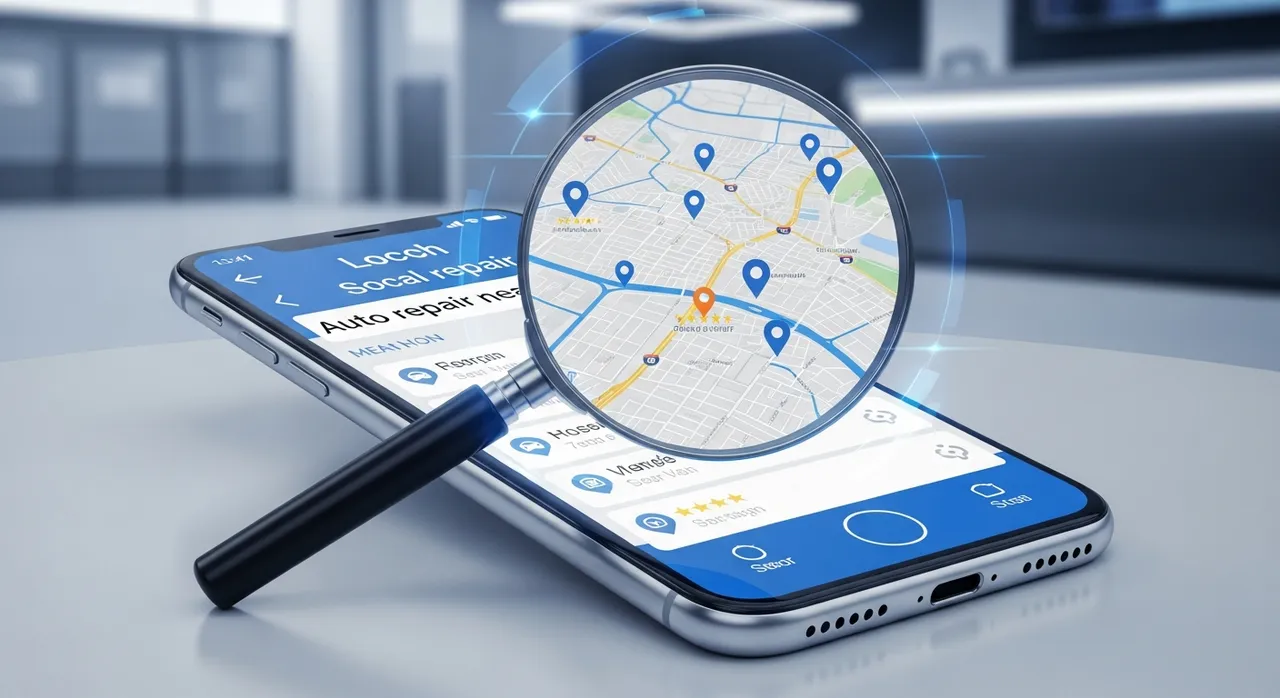
The vast majority of your new customers find you through one channel: local search. After an accident, drivers pull out their phone and search "auto body shop near me" or "collision repair in [city]." If you aren't in the top results, you're effectively invisible — and the repair order goes to a competitor. This guide breaks down exactly how collision centers win local search, step by step, in plain English.
Key takeaways
- The Google Map Pack — not the blue links — is where most body shop leads come from.
- Your Google Business Profile is your single most important local SEO asset.
- Dedicated, genuinely useful service-area pages help you rank in every city you serve.
- Consistent NAP and a steady flow of fresh reviews drive both rank and trust.
- Technical SEO (speed, mobile, schema) is the foundation everything else sits on.
Why local search decides who gets the repair order
Collision repair is an urgent, local, high-trust purchase. Nobody shops for a body shop weeks in advance — they search the moment they need one, usually from their phone, often from the scene of the accident or their driveway. That makes "near me" search the single most important marketing channel in the industry. And because the intent is so high, ranking even one position higher can mean several additional repair orders a month.
Here's the critical distinction: for a local service business, traditional national SEO matters far less than local SEO — ranking within a 10–15 mile radius of your shop. The main battleground is the Google Map Pack, the block of three businesses with a map that appears at the very top of local results. The Map Pack sits above every organic blue link and captures the lion's share of clicks and calls.
1. Optimize your Google Business Profile (your #1 asset)
Your Google Business Profile (GBP) is the most important local SEO asset you have. It's what powers your Map Pack listing, and Google rewards profiles that are complete, accurate, and active. Treat it like a living storefront, not a set-and-forget listing.
Get the fundamentals right
- Primary category: Set it to "Auto body shop." This single field has an outsized effect on what you rank for.
- Secondary categories: Add relevant ones like "Auto dent removal service," "Auto glass shop," or "Auto painting" if you offer them.
- Complete every field: Hours, services, attributes, service areas, and a keyword-rich (but natural) business description.
- Photos, constantly: Upload high-quality photos of your facility, team, and before/after work every week. Active profiles out-rank dormant ones.
Stay active with posts and Q&A
Use Google Posts to share specials, completed jobs, and updates. Seed and answer the Questions & Answers section with the things customers actually ask — "Do you work with my insurance?" "Do you offer free estimates?" Activity signals to Google that your business is alive and engaged, which supports your ranking.
2. Build service-area and localized content pages
If your shop sits in one city but serves several surrounding suburbs, you need dedicated service-area pages for each market — for example, "Collision Repair in [Suburb]." But here's the catch most shops get wrong: these pages must be genuinely useful and unique, not copy-pasted text with the city name swapped out. Google detects and ignores thin, duplicated pages.
A strong service-area page describes how you actually serve that community: landmarks, the types of vehicles common there, your turnaround, insurance partners, and real local proof like reviews from customers in that area. Your main service pages should also state clearly where you operate, and your homepage title tag should read something like "Auto Body Shop in [City] | [Shop Name]."
Don't forget service-specific pages
Beyond cities, build pages for the specific services people search: collision repair, dent removal, bumper repair, auto painting, frame straightening, and ADAS calibration. Each is a search someone is typing right now — and each deserves its own optimized page.
3. Keep your NAP consistent everywhere
NAP stands for Name, Address, and Phone number. Google uses citations — mentions of your business across directories, social platforms, and other sites — to verify you're legitimate and established. If you're "Precision Collision" on Yelp but "Precision Auto Body" on Facebook, or an old phone number lingers on a directory, it confuses search engines and quietly suppresses your rank.
Audit every place your business appears and standardize the exact same name, address, and phone number. Prioritize the listings that matter most for local rank: Google, Bing Places, Apple Maps, Yelp, and the major automotive directories.
4. Earn reviews — consistently, not in bursts
Reviews are one of the strongest local ranking factors and the single biggest driver of whether a searcher chooses you over the shop next to you. Two things matter: the overall rating and the velocity — a steady stream of fresh reviews signals an active, trusted business.
- Ask every happy customer at the moment of delivery, when satisfaction is highest.
- Make it effortless with a direct review link or QR code.
- Respond to every review — positive and negative — professionally and promptly.
- Automate the ask so it happens on every job, not just when someone remembers.
A simple automated review-request system can transform a shop's local presence within a few months. (See our Reputation & Reviews system for how we automate this end to end.)
5. Get the technical SEO foundation right
A slow website that doesn't render properly on a phone will be actively penalized by Google — and abandoned by customers. Your site needs clean code, fast hosting, a mobile-first layout, a logical heading structure (one H1, then H2s and H3s), and semantic markup (JSON-LD) that explicitly tells search engines you're an auto repair facility.
The technical checklist
- Speed: Aim for fast load times on mobile; every second of delay costs you rankings and leads.
- Mobile-first: The majority of body shop searches happen on phones — your site must be flawless there.
- Structured data: LocalBusiness and AutoRepair schema, reviews schema, and FAQ schema help Google understand and feature you.
- Crawlability: Clean URLs, an XML sitemap, and an internal linking structure Google can follow.
- Secure & stable: HTTPS everywhere and reliable hosting with no downtime.
6. Turn rankings into booked leads
Ranking is only half the job. Once a customer lands on your site, you have seconds to convert them. The shops that win pair strong local SEO with frictionless conversion: a click-to-call button that's always visible, an online photo estimate tool so customers can start a quote from their driveway, and instant follow-up so no lead goes cold. Traffic you don't convert is just expensive vanity.
Putting it all together: your local SEO roadmap
Local SEO isn't a single switch — it's a system where each piece reinforces the others. Start with a fully optimized Google Business Profile, build a fast and crawlable website with real local content, standardize your NAP everywhere, and create a steady engine of fresh reviews. Do these consistently and you'll climb the Map Pack, capture more high-intent searches, and build a lead channel you own rather than rent.
Frequently asked questions
How long does it take for a body shop to rank on Google?
Most collision centers see Google Map Pack movement within 60–90 days and meaningful gains by months 4–6. Local SEO compounds — the work you do in month one keeps paying off in month twelve.
Is the Google Map Pack more important than organic results for body shops?
For local service businesses like collision centers, yes. The Map Pack sits above the organic links and captures the majority of clicks and phone calls from high-intent 'near me' searches.
Do I need a blog to rank my body shop?
A blog isn't strictly required, but helpful local content — service explanations, repair guides, and city pages — gives Google more reasons to rank you and answers the questions customers ask before choosing a shop.
Can an independent shop out-rank national consolidators?
Yes. Local SEO rewards relevance, proximity, and review velocity over ad budget, so a focused independent shop regularly out-ranks much larger competitors in its own market.
Want a website built to rank from day one?
Your free listing on AutoRepairEstimate.ai is a fast, schema-rich directory page that doubles as your website at no cost — so you climb the Map Pack and convert the traffic into booked repair leads. The live photo-estimate widget already runs on it. For $99/month (founding rate, reg. $299) through AutoEstimatePro those estimate requests come straight to you. No setup fee, month-to-month.