
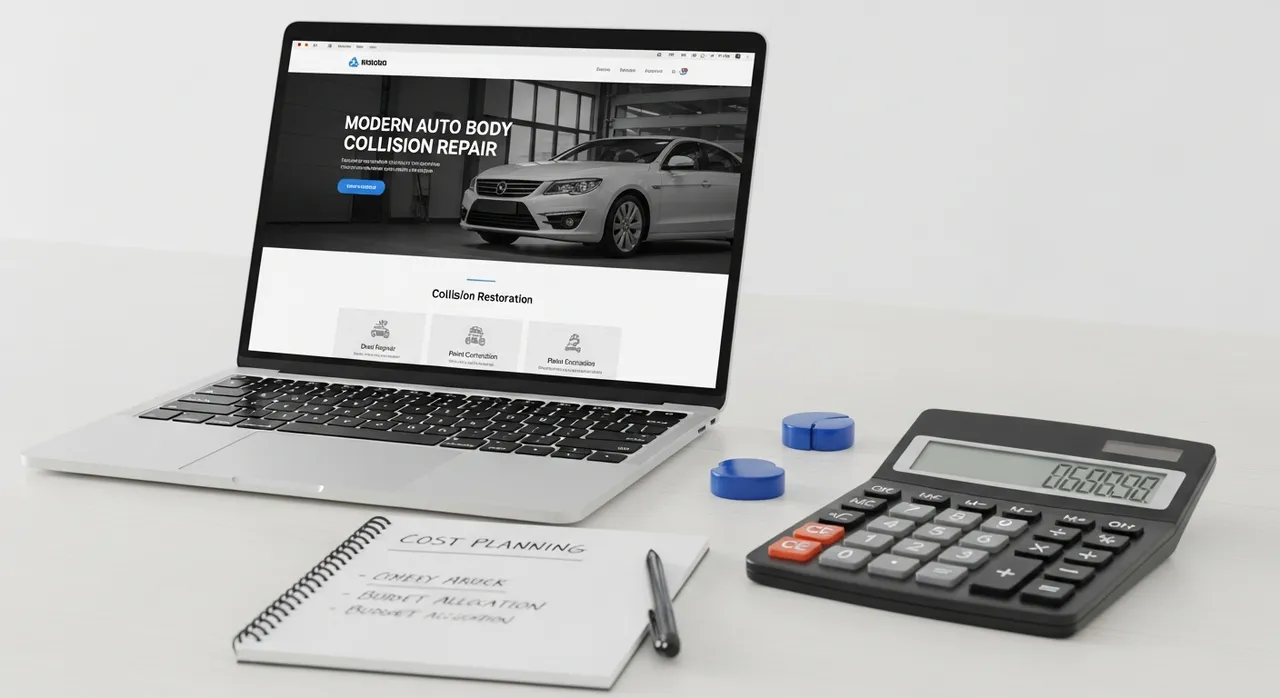
Ask three different web designers what a body shop website should cost and you'll get three wildly different numbers — $500, $5,000, $25,000. The answer feels arbitrary, but it isn't. The price gap exists because each tier is selling a fundamentally different product. This guide breaks down exactly what every price range gets you, what's missing, and what a body shop website actually needs to do to earn its keep.
Key takeaways
- A body shop website is an operational tool, not a brochure — price it by the leads it produces, not by pixels pushed.
- Sub-$1,000 template sites almost always lose money: no rank, no leads, and no collision-specific intake.
- Generalist agencies ($5K–$15K) deliver design but rarely understand DRP intake, photo estimates, or local SEO for collision shops.
- An industry-specific platform is usually the best value: a productized system spreads the engineering across many shops.
- Ongoing investment — hosting, SEO, content, review automation — is what protects the upfront spend from decaying.
Why "How much does a website cost?" is the wrong first question
A website isn't a deliverable like a brochure or a business card — it's a piece of software that produces revenue. The right question isn't "What does it cost?" It's "How many additional repair orders a month will it bring in, and at what total cost?" A $500 site that brings in zero leads is infinitely more expensive than a $5,000 site that produces three extra jobs a month. Once you reframe a website as a sales asset, comparing prices gets much easier.
The average collision repair order today is roughly $3,000–$5,000. A single additional booked job a month covers the entire annual cost of a serious website. The math isn't close — yet most shops still treat the website like an unwanted expense and pick the cheapest option. That's the trap this guide is designed to help you avoid.
Tier 1: The $300–$1,000 template site
At the lowest tier, you're paying a freelancer or template marketplace for a generic auto repair theme with your logo dropped in. The output looks acceptable from twenty feet away, and it technically "exists" on the internet. That's about all it does. These sites typically share code with thousands of other auto businesses, load slowly on mobile, have no collision-specific intake, no real schema markup, and no SEO strategy past plugging in your city name.
What you actually get
- A generic theme with stock photos and your contact information.
- A basic "Contact us" form with no collision intake fields.
- No structured data, no service-area pages, no review integration.
- Slow page load times — often 5–8 seconds on mobile, which Google penalizes.
The hidden cost: every month this site is live, you're missing leads that would have gone to a shop with a faster, more credible site. The "cheap" website is almost always the most expensive in opportunity cost.
Tier 2: The $3,000–$6,000 generalist agency build
Step up a tier and you'll find local marketing agencies that build genuinely custom designs, with adequate mobile performance and basic on-page SEO. The design will be better than a template, the photos will be original, and the agency will probably handle the launch for you. This is where most shops land — and it's where most shops get disappointed.
The reason is simple: a generalist agency doesn't understand the collision industry. They'll build a standard contact form because they've never seen a photo-estimate intake. They won't ask whether you're a DRP for State Farm or independent, so the messaging is vanilla. They'll miss the difference between drivable and non-drivable intake. They'll likely skip schema markup for AutoBodyShop. And six months later, when the site needs an update or the rank slips, you'll be in line behind every other client of that agency.
What's usually missing
- A real online photo estimate system with carrier/deductible/drivability questions.
- Insurance carrier logos and DRP/non-DRP positioning that fits your shop.
- Collision-specific schema (AutoBodyShop, Service, FAQPage, Review) baked into every page.
- Service-area pages built for every city you serve — not a single "service area" page with a list.
- Integrated review velocity and missed-call text-back.
Tier 3: The $10,000+ custom enterprise build
At the top end, you have premium agencies and freelancers who genuinely understand SEO and conversion design. They'll do customer interviews, run a competitive analysis, write copy, and build something polished. For a multi-location MSO with an in-house marketing person to manage the relationship, this can make sense. For a single-shop operator, it usually doesn't.
The problem isn't quality — it's that almost every "custom" build is solving problems other body shops have already solved. The intake form, the schema, the photo-estimate flow, the local SEO structure, the review automation — every one of those is a wheel that gets re-invented at $200/hour billing rates. You're paying premium prices for the agency's learning curve.
Tier 4: The industry-specific platform (the value sweet spot)
A productized platform built specifically for collision repair sits in a different category entirely. Instead of one agency hand-building a one-off site from scratch, a specialist team has built the core engine once and now configures it for each shop. That means you get the polish of a $15,000 custom build at a fraction of the price, and the platform keeps improving for every shop on it.
That's essentially what AutoRepairEstimate.ai now offers — except the page itself is free. List your shop and you get a fast, mobile-first directory page that doubles as your website at no cost — no setup fee and no build fee. The live photo-estimate widget already runs on it; for $99/month through AutoEstimatePro (founding rate, reg. $299) those requests come straight to you, month-to-month. Together they include:
- A professionally designed, mobile-first directory page that doubles as your website.
- The full online photo estimate intake system with carrier, deductible, and drivability questions.
- A backend lead inbox that organizes every request for your estimators with the photos and notes ready to review.
- The damage report engine backed by our 10,367-case correlation database, producing preliminary estimates that land within 10–15% of the final shop quote.
- A technical SEO foundation with collision-specific schema and service-area pages.
- Fast hosting, security, monitoring, and monthly content and optimization updates.
A comparable agency build would run $8,000–$15,000 upfront and $400–$800/month, often without any collision-specific photo estimate. A free directory listing plus the optional instant estimate widget makes serious infrastructure affordable for a single-location independent shop.
The hidden costs nobody quotes you
Sticker price is only one piece. Whatever route you take, factor in these recurring costs that almost always get missed in initial quotes:
- Hosting and security: $20–$200/month depending on stack and traffic.
- SSL, backups, monitoring: usually $20–$80/month if not bundled.
- SEO maintenance: $300–$1,500/month for ongoing optimization, citation cleanup, and content.
- Content updates: photos, blog posts, new service pages — $200–$1,000/month or 5–10 hours of internal time.
- Review automation and integrations: $50–$300/month for the tooling.
- Lead-form fixes and updates: hourly billing every time you want a change.
Add it up and the "cheap" site frequently ends up costing more than the productized platform — without producing the same leads. This is why we recommend evaluating cost on a 12- and 24-month basis, not just the day-one invoice.
What a body shop website must do to be worth the money
Regardless of which tier you choose, the website has to do specific jobs. If your current site isn't doing these, the cost question is moot — it's costing you money every month it's live.
- Load fast on a phone. 3 seconds or less. Slow sites lose Google rank and bounce mobile visitors.
- Communicate trust in 5 seconds. Hero, certifications (I-CAR, ASE, OEM), carrier logos, real photos of your shop.
- Capture leads where the customer is — at the curb. A click-to-photo-estimate path is non-negotiable in 2026.
- Rank for local intent. "Auto body shop near me," "collision repair in [city]," and service-specific searches.
- Integrate with your phone system. Click-to-call, missed-call text-back, and after-hours coverage.
- Tell your story credibly. Before/after galleries, owner bio, real reviews, and DRP/non-DRP positioning.
How to evaluate a body shop website proposal
When you're comparing quotes, the price gap usually shrinks once you put each proposal on a level playing field. Use this checklist:
- Is the photo-estimate intake included or extra?
- Is technical SEO included for the first year or sold separately?
- Are service-area pages included for every city you serve?
- Is hosting, SSL, backups, and uptime monitoring included?
- Who owns the site if you cancel? Can you take it with you?
- How fast are content updates turned around — and what's the hourly rate after the build?
- Does the team understand DRP/non-DRP, insurance flow, and drivability triage?
Get clear answers to those and the "cheap" quote often turns out to be the most expensive one once you add back what's missing.
What the right website actually does for your shop
A purpose-built collision repair website should pay for itself in the first 30–60 days. A single extra repair order per month from improved local rank and faster lead capture covers the entire monthly cost. By month six, most shops on a properly built system see meaningful Map Pack movement, a steady stream of photo-estimate leads, and after-hours capture from missed-call text-back. Compounded over a year, that's tens of thousands in incremental revenue from work you would have lost.
And because the platform is purpose-built for body shops, the engineering, design, and SEO work that already went into the system benefits your shop on day one — no learning curve, no generalist agency reinventing the wheel on your dime.
Frequently asked questions
What is a realistic budget for a professional body shop website?
For a website that actually drives repair leads — fast, mobile-first, schema-rich, with online estimate intake and SEO baked in — most shops should plan on $4,000–$10,000 up front and $200–$500/month in ongoing optimization and hosting. Anything dramatically cheaper is usually a template with no real strategy behind it; anything dramatically more expensive is typically a generalist agency padding the bill.
Should I buy a one-time website or a monthly subscription?
A website is software that needs ongoing care — speed monitoring, security patches, SEO updates, fresh content, and review integrations. A flat one-time build that sits untouched for two years almost always loses rank and conversion. A small monthly fee that covers hosting, monitoring, SEO, and content updates protects the up-front investment and keeps the site producing leads.
Why do template sites usually fail for body shops?
Generic templates are designed to look like a brochure, not to capture repair leads. They lack collision-specific intake (photo estimates, insurance, drivability, deductible), they're often slow, they share code with thousands of other sites, and their on-page SEO isn't built around the searches that actually drive collision work like 'auto body shop near me' or 'collision repair in [city].'
Is custom always better than productized?
Not for an independent body shop. A productized, industry-specific platform has already solved the same problems your shop has — intake forms, schema, photo estimates, missed-call recovery — and the cost is spread across many shops. A truly custom build from a generalist agency usually costs 3–5x more without producing better leads.
How does a free directory listing plus the $99/month instant estimate widget compare to other options?
Your free listing on AutoRepairEstimate.ai is a fast, mobile-first directory page that doubles as your website at no cost — no setup fee and no build fee. The only paid product is the live photo-estimate widget, which turns visitors into booked jobs for $99/month (founding rate, reg. $299) through AutoEstimatePro, month-to-month. Comparable agency builds typically run $8,000–$15,000 upfront plus $400–$800/month, often without any collision-specific photo estimate at all.
Enterprise polish at a transparent price.
Get a free listing on AutoRepairEstimate.ai — your shop page doubles as a fast, mobile-first website at no cost, with no setup fee and no build fee. Your page comes with the live photo-estimate widget already running on it. For $99/month (founding rate, reg. $299) through AutoEstimatePro those estimate requests come straight to you. Month-to-month, cancel anytime.