
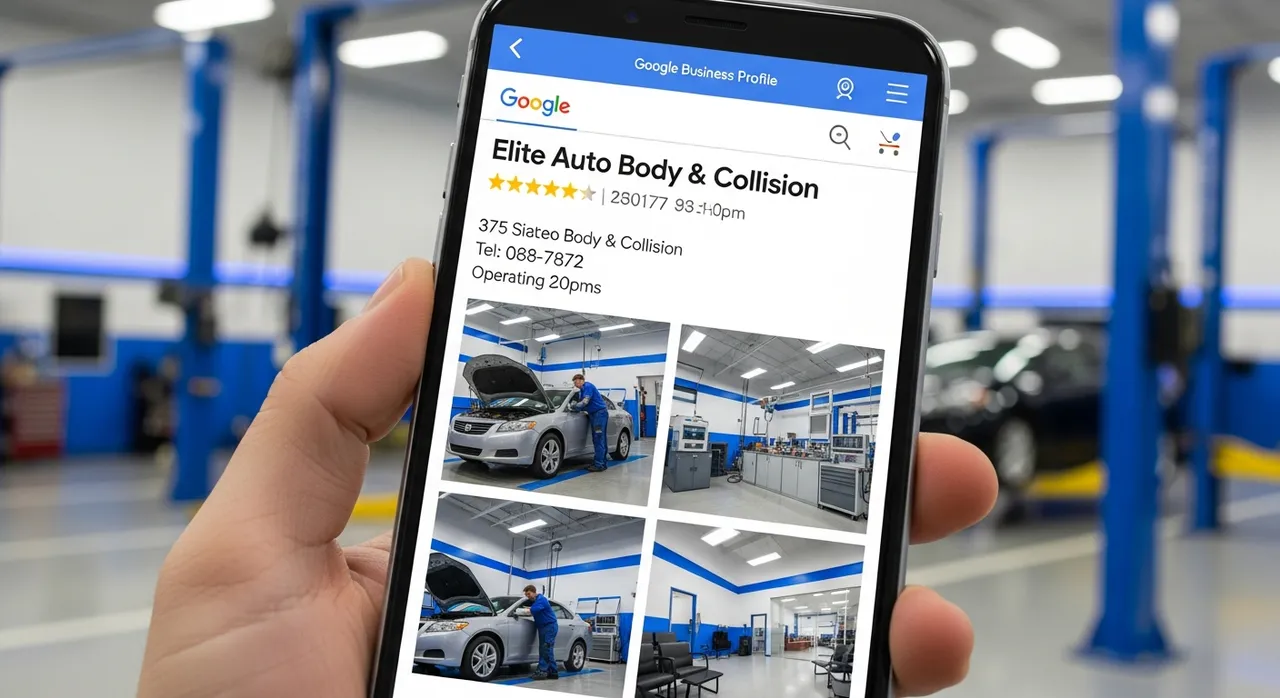
For a body shop, your Google Business Profile (GBP) is arguably more important than your website. When a driver in your city searches "auto body shop near me" or "collision repair," Google shows three businesses on a map at the very top of the results — the Map Pack — before any blue links. Your GBP is what determines whether you're one of those three or buried out of sight. This is the complete optimization guide we use to push collision centers into the top of their local market.
Key takeaways
- Set your primary category to "Auto body shop" — it's the highest-leverage field on the profile.
- Review velocity (fresh reviews every week) matters more than total review count.
- Profiles that post weekly and upload photos consistently out-rank dormant ones.
- NAP consistency between your site and GBP is a hidden but powerful ranking factor.
- Q&A is unmoderated — seed it with your own questions before a competitor or troll does.
Why GBP is the foundation of collision-shop marketing
A customer searching for a body shop is almost always stressed, rushed, and looking for immediate reassurance. Their vehicle is damaged. They might be standing on the side of the road. They want answers fast: Are you open? Where are you? Do other people trust you? Can I see your work? Your GBP delivers (or fails to deliver) all of that in the first three seconds.
If your profile is barren — generic category, two grainy photos, four reviews from 2019, no posts — that customer scrolls past you in seconds. If it's complete, active, full of recent photos and reviews, with clear services and a "Get Directions" button right there, you win the click. The gap between a great GBP and a mediocre one is worth dozens of repair orders a month. Here's how to close it.
1. Nail your categories
Your primary category is the single most heavily weighted ranking factor in the Map Pack. It tells Google exactly which searches you should appear in. For a collision center, set it to Auto body shop. Do not default to "Auto repair shop" — that's a mechanical-repair category and it will quietly suppress you for collision-specific queries.
Secondary categories that pull their weight
Add secondary categories for every legitimate service you offer. Each one expands the searches you can appear in:
- Auto dent removal service — captures PDR searches.
- Auto painting — for paintwork and refinishing queries.
- Auto glass shop — if you do or sublet glass.
- Auto bodywork mechanic — picks up additional collision queries.
- Auto restoration service — if you do classic or restoration work.
Don't pad with categories you don't actually serve — Google can detect mismatches between your profile and your website content, and it hurts you.
2. Treat photos like a weekly habit
Listings with active, ongoing photo uploads receive substantially more direction requests, calls, and website clicks than dormant ones. Google looks at both quantity and recency. A profile that adds 5–10 fresh photos a month is a strong, active business in Google's eyes. One that hasn't been touched in a year looks abandoned.
What to photograph
- Clean, well-lit repair bays (no clutter, no dirty rags in frame).
- Your paint booth, frame rack, and any specialty equipment.
- High-quality before/after pairs of completed repairs — this is your single best content.
- Your team — techs, advisors, ownership — putting real faces on the business.
- Your exterior and signage from the street so customers recognize you on arrival.
Skip the blurry phone snaps of messy work areas. Quality matters. If you don't have the time or eye for it, our Before & After Repair Content service can build and maintain a professional library for you.
3. Max out the Services section
The Services section is one of the most under-used parts of GBP. Most shops fill in three or four generic items and stop. Don't. Every service you list becomes a potential long-tail search you can rank for.
Add an entry for every meaningful service you provide, each with a 1–2 sentence description that uses the exact terms customers search. A starter list for a typical collision center:
- Collision Repair
- Paintless Dent Repair (PDR)
- Bumper Repair & Replacement
- Auto Painting & Refinishing
- Frame Straightening
- ADAS Calibration
- Hail Damage Repair
- Insurance Claim Assistance
- Free Estimates / Online Photo Estimates
- Towing Coordination
This is also where you can mention your online estimate flow — link customers to your photo-estimate page directly from your profile description.
4. Use Google Posts every single week
Google Posts are the closest thing GBP has to a social feed. They appear inside your profile and on your Map Pack listing, and they're a strong activity signal. A profile that posts weekly looks alive; one that hasn't posted in months looks closed.
What to post
- Completed job posts — short caption + before/after photo. The highest-converting format.
- Offers — free estimates, fleet discounts, deductible assistance where allowed.
- Seasonal updates — winter prep, hail-season reminders, summer road-trip safety.
- Community involvement — sponsorships, charity work, local events.
- Service spotlights — explain ADAS calibration, PDR, OEM-approved repairs.
Each post should end with a clear call to action: Call, Get Directions, or Request an Estimate.
5. Master the Q&A section
The Q&A section is one of the most overlooked — and risky — parts of GBP. Anyone can post a question, and anyone can answer it. If you don't manage it, you'll end up with random users (or competitors) answering questions about your business with bad or wrong information.
Seed it yourself first
Best practice: post and answer the most common questions yourself, from the owner account. This gives Google more keyword-rich content tied to your profile and locks in correct answers before anyone else can muddy them.
- "Do you offer free estimates?"
- "Do you work with my insurance company?"
- "How long does collision repair typically take?"
- "Do you handle ADAS calibration?"
- "Do you provide a lifetime warranty on repairs?"
- "Can I get an estimate online without coming in?"
Check the section weekly and respond to anything new within 24 hours.
6. Build a steady review pipeline
We cannot stress this enough: reviews are simultaneously the strongest local ranking signal Google uses and the single biggest factor in whether a customer picks you. A profile with 200+ reviews at 4.8 stars beats a profile with 15 reviews at 5.0 nearly every time.
What "review velocity" really means
Google rewards consistency. A shop that earns 10 new reviews a month, every month, is a stronger ranking signal than a shop that got 200 reviews two years ago and nothing since. The fix is automation: trigger a review request to every customer at the moment of vehicle delivery, when satisfaction is peak.
Responding to reviews
Respond to every review — positive and negative — within 24 hours. For positive reviews, a short thank-you with the customer's name and a mention of the work performed (e.g., "thanks for trusting us with your Honda Pilot bumper") gives Google more relevant content tied to your profile. For negative reviews, stay calm, acknowledge, and offer a phone number to resolve offline. Never argue or expose customer details publicly.
Our Reputation & Reviews system runs the request → response → reporting loop end-to-end. For a deeper look at how reviews tie into overall local rank, see our Body Shop SEO Guide.
7. Keep NAP perfectly consistent
NAP — Name, Address, Phone — must be byte-identical between your GBP, your website, and every directory listing (Yelp, Bing, Apple Maps, automotive directories). Even small mismatches like "St" vs "Street" or an old phone number can quietly suppress your rank because Google can't fully verify your business identity.
Audit your top 20 listings, standardize the exact same NAP everywhere, and update the data aggregators that feed smaller directories. This is unglamorous work, but it's one of the highest-ROI optimizations you can do.
8. Connect GBP to a website that converts
All the GBP optimization in the world is wasted if customers click through to a website that's slow, unconvincing, or hard to use on a phone. Your GBP "Website" link should point to a page with:
- A click-to-call button always visible on mobile.
- An obvious entry point to your online photo estimate.
- Recent reviews, before/after photos, and trust signals above the fold.
- Service-area content that confirms you serve their city.
And every missed call should auto-text the caller a photo-estimate link via missed-call text-back — so even when GBP delivers a lead you can't answer in person, you don't lose them.
9. Track what's actually working
GBP gives you free Insights — direction requests, calls, photo views, search queries you appeared for. Check it monthly. Look for which queries are driving discovery, which photos are getting clicks, and which posts are converting. Double down on what works.
Putting it all together
A fully optimized Google Business Profile is not a set-and-forget task; it's an ongoing rhythm. Correct categories, weekly posts, weekly photo uploads, seeded Q&A, a steady drip of fresh reviews, sub-24-hour responses, and tight NAP consistency — all pointing to a page built to convert. Do this for 60–90 days and you'll see real Map Pack movement. Do it for six months and you'll own your local search results.
Our GBP Growth service runs this entire loop for shops that would rather fix bumpers than manage a profile. Combined with our Local SEO system, it's how independent collision centers consistently out-rank national consolidators in their own backyard.
Frequently asked questions
What primary category should a body shop use on Google Business Profile?
Use 'Auto body shop' as the primary category. This single field has an outsized effect on which searches you appear in. Do not use 'Auto repair shop' as primary unless mechanical repair is your main business — it will dilute your ranking for collision-specific queries. Add secondary categories like 'Auto dent removal service,' 'Auto painting,' or 'Auto glass shop' to capture additional service searches.
How often should I post on my Google Business Profile?
At least once per week — and ideally 2–3 times. Active profiles out-rank dormant ones. Mix in completed-job photos, current offers, seasonal reminders (winter prep, hail season), and short updates. Google rewards consistency more than any single post, so a steady cadence beats occasional bursts.
How many reviews does a body shop need to compete in the Map Pack?
There's no magic number, but in most U.S. metros the top three Map Pack slots have 100+ reviews each, and the leaders have 250+ with a 4.7+ rating. More important than the absolute count is the velocity — a steady drip of fresh reviews signals an active, trusted business. A shop earning 8–15 new reviews a month will out-rank a static profile of 300 reviews from two years ago.
Should I respond to negative reviews on my Google Business Profile?
Always — and within 24 hours. A professional, calm response to a negative review actually builds more trust with future customers than the negative review damages, because it shows accountability. Never argue, never expose customer details, and never get defensive. Acknowledge, take it offline with a phone number, and invite resolution.
Will photos actually help my Google Business Profile rank?
Yes, and meaningfully. Profiles with regularly uploaded photos get significantly more clicks, direction requests, and calls. Google also uses photo activity as a freshness/engagement signal. Aim for at least 5–10 new photos per month: facility shots, your team, completed work, and before/after pairs. Avoid blurry phone snaps of messy areas — quality matters.
Maximize your local visibility.
Claim your free listing on AutoRepairEstimate.ai — your shop page doubles as a fast, mobile-first website at no cost, with no setup fee. Your page comes with the live photo-estimate widget already running on it. For $99/month (founding rate, reg. $299) through AutoEstimatePro those estimate requests come straight to you. Month-to-month, cancel anytime.