
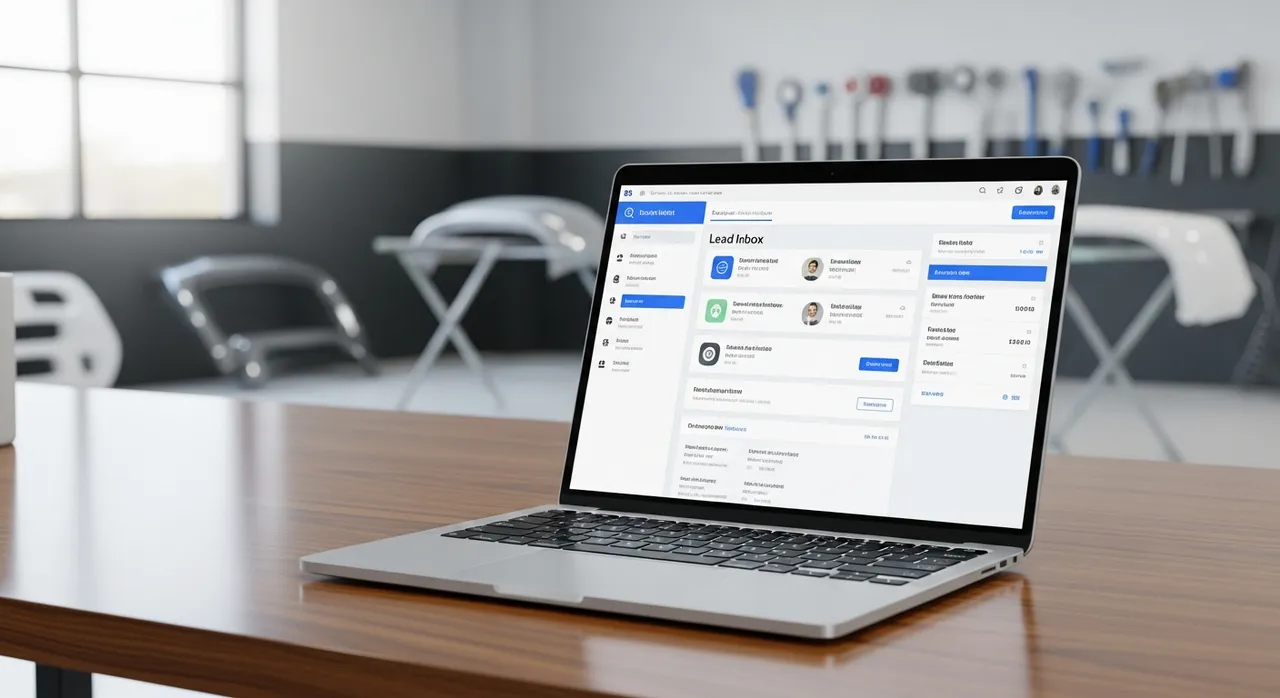
Ask any body shop estimator where their day actually goes, and you'll hear the same answer: phone calls to get vehicle information, re-entering data that customers already submitted somewhere, chasing photos, decoding VINs, looking up parts prices, and trying to piece together a coherent starting point before they can write a single line. The actual estimating — the judgment work that requires expertise — often represents less than half of their time. Automated estimating software doesn't replace your estimator's expertise. It eliminates everything that's eating the time around it.
Key takeaways
- The average estimator spends 30–60 minutes per estimate on data entry and intake before writing the first line — automated intake eliminates most of that.
- Automated systems don't replace CCC ONE, Mitchell, or Audatex — they produce a structured report your estimator reads and references while writing the final estimate in their existing platform.
- Faster estimates mean faster approvals, faster production starts, and more jobs completed per bay per month.
- Shops that automate intake write more estimates per day with the same number of estimators — without burning anyone out.
- A structured preliminary estimate is also a stronger supplement document when adjusters write low.
Where estimator time actually goes — and where it shouldn't
A body shop estimator's core skill set is damage assessment: knowing which panels need replacing vs. repairing, which OEM procedures apply, how to read hidden damage, and how to write a defensible sheet. That skill set took years to develop and is genuinely hard to replace.
What's also genuinely replaceable — with software that already exists — is everything that happens before the estimator can apply that expertise:
- Calling the customer back to get their VIN.
- Looking up the vehicle's year, make, model, and trim to pull the right OEM procedures.
- Emailing back and forth to get usable photos.
- Re-entering carrier information the customer already gave to a front-desk form.
- Pulling parts prices from multiple vendor catalogs to get a starting point.
- Typing out the same "preliminary estimate" disclaimer language on every sheet.
In a shop writing 20 estimates a week, this front-end waste can consume 40+ hours of estimator time — time that could be spent on production floor involvement, supplement writing, customer communication, or simply handling more volume.
How automated intake compresses the estimate timeline
Automated estimating software compresses the estimate timeline by handling the structured, repeatable parts of the intake automatically, so the estimator's involvement starts at the point where their expertise actually adds value.
Here's how the workflow changes:
The traditional estimate process
- Customer contacts the shop (phone, form, walk-in).
- Front desk takes down name, contact, basic damage description.
- Estimator contacts customer for vehicle information.
- Customer provides VIN or Year/Make/Model — sometimes wrong or incomplete.
- Estimator requests photos via text or email.
- Photos arrive — sometimes days later, sometimes unusable.
- Estimator manually decodes VIN, looks up OEM procedures, prices parts.
- Estimator writes the estimate from scratch in CCC ONE.
- Estimate is sent to customer — typically 24–72 hours after first contact.
The automated estimate process
- Customer visits the shop's website and starts the photo-estimate intake flow.
- The system captures VIN (auto-decoded), damage photos (guided by panel prompts), drivability, and carrier information.
- In about 60 seconds, the estimator's inbox receives a structured report: damage classification, severity, OEM procedures, labor hours, and live parts pricing.
- Estimator reviews the structured report, applies their judgment, and writes the final estimate in their existing platform.
- Estimate is sent to customer — often within minutes of first contact.
The difference in speed is dramatic. More importantly, the difference in estimator experience is significant: instead of doing data-entry tasks they're overqualified for, they're doing the judgment work they were hired to do.
What the automated damage report contains
The output of an automated estimate intake isn't a vague "bumper damage" note. Our AutoEstimatePro damage report uses a structured 5-step classification framework applied to every submission:
- Detection Classification — Is the damage primary (direct impact), related (consequential), or inferred (likely hidden given the damage pattern)?
- Damage Type — Physical classification: bent, broken, gouged, scratched, deformed, or separated — each requiring a different repair path.
- Severity Rating — Severe, moderate, or minor — matched against the repair data from our 10,367-case correlation database.
- Action Decision — Replace, repair, or inspect — the same framework your estimator uses, now pre-applied based on damage classification.
- Labor Hours — Pulled from our database by year, make, model, and damage type, serving as a verified starting point for the estimator's sheet.
Alongside this classification, the report includes live parts pricing from 200+ vendors (OEM, aftermarket, LKQ, eBay Motors) pulled at the moment of submission — so the estimator isn't spending time researching prices that change daily.
Working alongside CCC ONE, Mitchell, and Audatex
The most important thing to understand about automated estimating software is what it is not: it is not a replacement for the estimating platform your shop already uses — and we have no official partnership or certification with CCC ONE, Mitchell, or Audatex. It is a front-end intake and report generator that produces a structured damage report your estimator reads and references while writing the final estimate in whatever platform they already use.
Your estimator still writes the final estimate in CCC ONE. They still manage the supplement process the way they always have. They still maintain your DRP relationships through the same platforms. What changes is the quality and completeness of the starting point they're working from.
Think of it as the difference between showing up to a job with a clean blueprint vs. a napkin sketch. The tradesperson's skill is the same either way — but one setup produces a faster, cleaner result.
The estimator capacity math
Let's look at what faster estimates actually do to a shop's capacity.
Assume a single estimator writing 20 estimates per week. Under the traditional process, 40% of their time is consumed by intake tasks — that's the equivalent of 2 full days per week of non-estimating work. Automated intake eliminates most of that overhead, freeing 15–20 additional estimating hours per week.
With that recovered capacity, the same estimator can write 30–35 estimates per week instead of 20 — without working longer hours, without rushing, and without sacrificing quality on the judgment calls. For a shop where each booked repair represents $3,000–$5,000 in revenue, that additional capacity translates to real bottom-line impact from the same headcount.
Alternatively, a shop that's been considering hiring a second estimator to handle growing volume might find that automating intake solves the capacity problem at a fraction of the cost of a full-time hire.
Speed as a competitive weapon in collision repair
Here's the part of the estimate speed conversation that shops often overlook: customers are shopping multiple shops simultaneously. The collision repair customer is usually anxious, without a vehicle, under pressure from their carrier, and contacting two or three shops at once. The shop that gets them an estimate first — credible, detailed, and professional — wins a significant conversion advantage regardless of price.
When a competitor is quoting 24–48 hours to get back to a customer and your shop delivers a preliminary estimate within minutes, you've already differentiated yourself before the customer has made a single decision. That speed signals competence, professionalism, and responsiveness — exactly the qualities a collision customer is trying to evaluate.
Speed also matters for DRP referrals. Carriers monitor their preferred shops on cycle time and customer satisfaction metrics. Shops that consistently write fast, accurate estimates and maintain short cycle times attract more referrals and better DRP terms. Automated intake is one of the most direct levers a shop can pull to improve both numbers.
Making the estimate accurate enough to act on
A common concern is accuracy: can an automated estimate really be reliable enough to use with customers? The short answer is yes — with appropriate framing. Our estimates are built on a 10,367-case correlation database that matches damage patterns to real repair outcomes, combined with live parts pricing updated at the time of each submission. In testing against shop-written quotes, automated preliminary estimates land within 10–15% of the final shop quote in the majority of cases.
That accuracy range is more than sufficient for setting customer expectations, qualifying the job, ordering long-lead parts, and opening a repair order. It's clearly framed as preliminary — every report includes a disclaimer that the final estimate is set after shop inspection and teardown — so the customer understands the number may adjust.
In practice, this preliminary accuracy level also means fewer surprises in either direction at final write-up, which reduces the supplementing required and keeps the relationship with the customer clean.
Beyond the estimate: the full connected intake workflow
Automated estimating works best when it's part of a fully connected intake system, not a standalone tool. The estimate is the centerpiece, but the complete workflow includes:
- Instant SMS acknowledgment to the customer the moment their submission is received.
- Automated follow-up for leads that submitted photos but didn't complete the full intake flow.
- Lead routing to the right estimator, location, or queue based on drivability, carrier, or damage type.
- Missed-call text-back for customers who called instead of using the online form — sending them directly to the intake flow.
- CRM-ready summaries formatted for your shop management system inbox.
When all of these pieces work together, the gap between first customer contact and a complete, actionable lead in the estimator's inbox compresses from hours to minutes. Our Lead Response Automation system connects all of these elements into a single platform so you're not stitching together five different tools.
Common implementation questions
What about customers who don't want to use an online tool?
You keep your phone line, your walk-in process, and your existing front-desk workflow exactly as they are. The online intake is an additional channel that captures leads who reach you digitally — especially after hours and on weekends, when your phones are unattended. Walk-ins and phone-in customers aren't excluded; many shops set up a QR code to route those customers into the same intake flow while they're in the shop.
How long does setup take?
The widget is quick to turn on. Once your free listing is claimed on AutoEstimatePro and the intake questions are customized to your shop's workflow (carrier preferences, routing rules, follow-up timing), the live photo-estimate widget goes live on your directory page. Most shops are up and running within the same week — there's no website to build and no setup fee.
What if my estimators push back on changing their process?
In practice, estimators embrace this quickly — because it removes work from their plate, not adds to it. The common pushback is front-office process resistance, not estimator resistance. Once an estimator experiences opening their inbox to a fully documented, triaged, and pre-estimated lead instead of a vague "customer called about a fender bender," the old way stops sounding appealing fast.
The bottom line on writing estimates faster
The fastest path to more completed jobs and more revenue isn't hiring another estimator — it's making your current estimators faster. Automated intake eliminates the data-entry and information-chasing work that consumes 30–60% of a typical estimator's time, freeing that capacity for the judgment work that only they can do. The result is more estimates written per day, faster turnarounds for customers, and a measurable improvement in throughput — all without burning out your team or adding headcount. If you're writing estimates in 2026 the same way you did in 2016, it's time to look at what's changed.
Frequently asked questions
How much time does automated intake actually save per estimate?
Shops using automated photo-estimate intake report saving 30–60 minutes per estimate on the intake and data-entry portion alone. When the customer has already submitted VIN, photos, drivability, and carrier information — and your system has pre-classified the damage and pulled parts pricing — your estimator starts from a structured report instead of a blank page. The time savings compound when you multiply across 20–40 estimates per week.
Does this work with my current CCC ONE setup, or do I need to replace anything?
It works alongside CCC ONE, not instead of it — though we have no official partnership or certification with CCC ONE. Our automated intake produces a structured damage report your estimator reads and references while writing the final estimate in CCC ONE or any other platform. Nothing about your existing workflow, carrier relationships, or supplement process changes.
What if the customer uploads bad photos?
The intake flow guides customers through the photo process with prompts — front, rear, each damaged panel, close-up detail. If photos are unclear, the system flags them and can send an automated follow-up requesting additional shots before the report is generated. The goal is to get good inputs the first time, but the flow is designed to catch and correct poor submissions before they reach your estimator.
Can I use automated estimates for walk-in customers, not just online leads?
Yes. Many shops set up a QR code at the front desk or service drive that opens the intake flow on the customer's phone while they're standing in the shop. The estimator gets the structured report in about 60 seconds — faster than the customer finishes signing the check-in paperwork. It works identically whether the customer is across town or standing in front of you.
How does the system handle supplements?
The automated intake generates a preliminary estimate based on visible damage. Hidden damage identified during teardown still requires a supplement — and that process stays in CCC ONE exactly as it does today. What the automated system does is ensure the opening estimate is as complete as possible based on visible damage, reducing the number of supplements needed and improving the documentation available when you do need to write one.
Write better estimates in less time.
Our live photo-estimate widget captures VIN, photos, and carrier information from any mobile device and delivers a structured, line-item damage report to your estimator's inbox in about 60 seconds — so they can write the final estimate faster in whatever platform they already use. List your shop free on AutoRepairEstimate.ai — the widget is already on your page — then subscribe for $99/month (founding rate, reg. $299) through AutoEstimatePro to get the requests delivered to you. No setup fee, month-to-month.